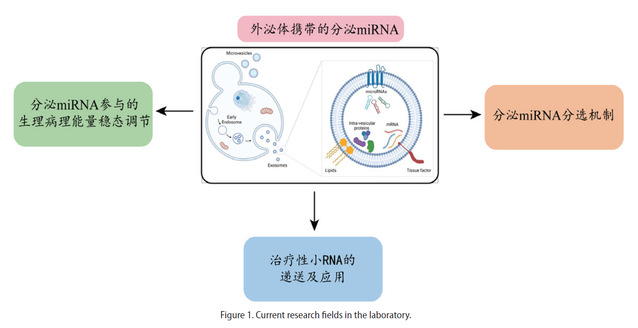
ResumeJing Li received her Ph.D. degree in Biology (2006-2011) from the School of Life Sciences, Nanjing University. From 2011 to 2017, she worked as an assistant researcher under the guidance of Dr. Chen-Yu Zhang focusing on metabolic role of islet-derived secreted miRNA. From 2017, she started her associate professor position in the area of pathophysiology and application of secreted small RNA. In 2019, she worked as a visiting scholar at Institute of Metabolic Science, University of Cambridge, in the area of metabolic disease. Research FieldsThe pathophysiology of secreted miRNA miRNAs exert their functions not only within the cells, but also can be actively secreted via extracellular vesicels and manipulate functions in other distant cells or organs. These secreted miRNAs, therefore, are considering as alternative secretory factors that mediate cell-to-cell communications. Jing Li and her co-workers found that secreted miRNAs are implicated in glucose metabolism. Under high level of free fatty acids (FFAs) condition, pancreatic islets can secrete miRNAs to regulate glucose metabolism in liver by targeting insulin signalling pathways. Meanwhile, they found that secreted miRNAs play a role in initiating the reprogramming of glucose metabolism during some pathophysiological status, such as cancer or gestation. To further understand the biological roles of secreted miRNAs, Jing Li and her co-workers have also been investigating the mechanism that controls the selective packaging and releasing of miRNAs. In the light of the fact that small RNAs can be packaged and delivered via extracellular vesicles (EVs), they utilized EV to deliver therapeutic siRNAs for gene therapy. By utilizing a more e cient and economical in vivo self-assemble deliver system, they deliver siRNA into central nerve system and significantly inhibit the growth of glioblastoma.
Part-time Academic JobWork ExpericeAchievement1. Jing Li, Yujing Zhang, Yangyang Ye, Dameng Li, Yuchen Liu, Eunyoung Lee, Mingliang Zhang, Xin Dai, Xiang Zhang, ShibeiWang, Junfeng Zhang, Weiping Jia, Ke Zen, Antonio Vidal-Puig*, Xiaohong Jiang*, Chen-Yu Zhang*. Pancreatic β cells control glucose homeostasis via the secretion of exosomal miR-29 family. J Extracell Vesicles 2021Jan;10(3): e12055. Epub 2021 Jan 21. 2. Y. Ye, X. Zhang, F. Xie, B. Xu, P. Xie, T. Yang, Q. Shi, C. Zhang, Y. Zhang, J. Chen*, X. Jiang* and J. Li*. An engineered exosome for delivering sgRNA:Cas9 ribonucleoprotein complex and genome editing in recipient cells. Biomater. Sci., 2020, May 19; 8(10): 2966-2976. 3. Ding H, Zheng S, Garcia-Ruiz D, Hou D, Wei Z, Liao Z, Li L, Zhang Y, Han X, Zen K, Zhang CY*, Li J*, Jiang X*. Fasting induces a subcutaneous-to-visceral fat switch mediated by microRNA-149-3p and suppression of PRDM16. Nat Commun. 2016 May 31; 7: 11533. 4. Zheng Fu#, Xiang Zhang#, Xinyan Zhou#, Uzair Ur-Rehman#, Mengchao Yu#, Hongwei Liang#, Hongyuan Guo, Xu Guo, Yan Kong, Yuanyuan Su, Yangyang Ye, Xiuting Hu, Wei Cheng, Jinrong Wu , Yanbo Wang, Yayun Gu, Sheng-feng Lu , Dianqing Wu, Ke Zen, Jing Li*, Chao Yan*, Chen-Yu Zhang* and Xi Chen*. In vivo self-assembled small RNAs as a new generation of RNAi therapeutics. Cell Research (2021) 0: 1-18 5. Liu Y, Liu R, Yang F, Cheng R, Chen X, Cui S, Gu Y, Sun W, You C, Liu Z, Sun F, Wang Y, Fu Z, Ye C, Zhang C*, Li J*, Chen X*. miR-19a promotes colorectal cancer proliferation and migration by targeting TIA1. Mol Cancer. 2017 Mar 4; 16(1): 53. Awards |